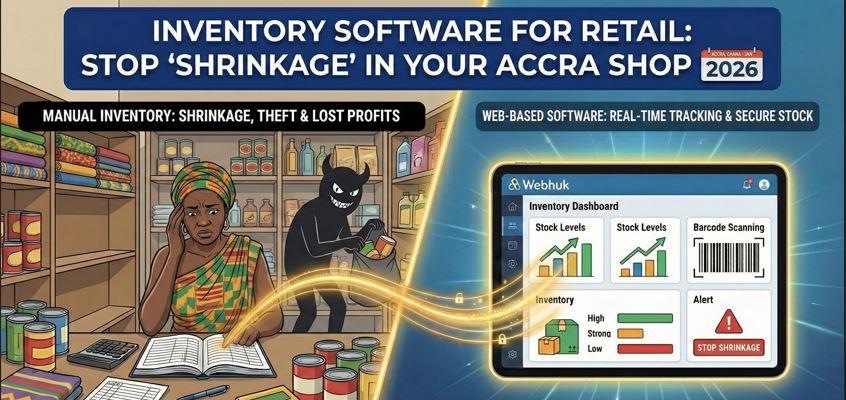
There is a saying among Ghanaian shop owners: "It is not what you sell that makes you rich; it is what you keep."
You might have a busy shop in Osu, Madina, or Adum. Customers are flowing in. Sales are happening. But at the end of the month, when you check your bank balance, the numbers don't add up.
Where did the profit go?
The answer is often Shrinkage. Shrinkage is the polite business term for theft, damage, or administrative error. In Ghana’s retail sector, it is a silent killer. A few tins of milk missing here, a box of tiles broken there, or a cashier pocketing cash for an unrecorded sale.
If you are running your shop on trust and a notebook, you are leaving the door open for these losses.
To close that door, you need Inventory software for retail.
In this guide, we will explore how moving from manual counting to digital tracking can save your shop millions in lost stock and give you back control of your business.
The High Cost of "Estimating"
Many retailers manage stock by "eye-balling" it. You look at the shelf, see it's half-empty, and call the supplier.
This method fails for three reasons:
1. The "Back Door" Problem
If you don't know exactly how many units you should have, you can't prove when they go missing. Dishonest staff know this. If they take one item a day, you will never notice. Over a year, that is 365 items lost. With inventory software for retail, every single unit is accounted for. If the system says you have 50, and you count 49, you know a theft happened, and you can investigate immediately.
2. The "Dead Stock" Trap
In a humid climate like ours, stock spoils. If you sell food, cosmetics, or medicine, expiry dates matter. Without software, old stock gets pushed to the back of the shelf. By the time you find it, it has expired and must be thrown away. That is cash in the trash. Software tracks "First-In, First-Out" (FIFO), reminding you to sell the oldest items first.
3. Running Out of Best-Sellers
Nothing hurts more than a customer waving money at you for a product you don't have. Manual tracking is reactive. You only realize you are out of stock after it runs out. Digital tracking is proactive. It alerts you: "You have 5 units of Rice left. Reorder now to arrive by Friday."
Features That Protect Your Profit
When choosing inventory software for retail in Ghana, look for these specific tools:
Barcode Scanning
Stop typing product names. It is slow and leads to mistakes. Get a simple USB barcode scanner (they are cheap).
- Speed: You can scan 20 items in the time it takes to type one.
- Accuracy: You never accidentally sell the wrong size or flavor.
- Professionalism: Customers trust a shop that scans items. It feels like a supermarket.
Real-Time Stock Updates
If you sell on Jiji, WhatsApp, and in your physical shop, you have a problem. What if you sell your last blender on WhatsApp, but a customer walks into the shop 5 minutes later to buy it? Good software syncs everything. When a sale happens anywhere, the master inventory count drops instantly, preventing "overselling."
Audit Trails
This is your security camera for data. If a cashier deletes a sale or changes a stock number, the software records it. "User ‘Kojo’ changed stock of Soap from 10 to 5 at 4:32 PM." You can ask Kojo exactly why he did that. The fear of being caught is often enough to stop theft before it starts.
Managing Multiple Locations
If you are successful enough to open a second branch, your inventory problems double.
- "Does Branch A have the shoe size that Branch B needs?"
- "Did the driver actually deliver all 50 boxes to the new shop?"
Inventory software for retail centralizes this. You can see the stock levels of all branches from your phone. You can initiate "Inter-Branch Transfers" digitally, creating a chain of custody so that if items go missing in transit, you know who is responsible.
Conclusion: Stop Working for Your Staff
When you don't track inventory, you are essentially letting dishonest staff or inefficient processes take a salary from your profits.
Implementing Inventory software for retail isn't about not trusting your team; it's about removing the temptation. It creates a culture of accountability.
Your stock is your money. Treat it with the same respect you treat the cash in your till.
Ready to secure your shop? Webhuk provides robust, easy-to-use inventory tools designed for the high-volume, fast-paced nature of Ghanaian retail.
Frequently Asked Questions (FAQs)
1. Do I need to barcode every single item?
Ideally, yes. But for loose items (like tomatoes or nails sold by weight), the software can generate "generic" codes or shortcuts on the screen so you can tap them quickly without scanning.
2. Can I use the software on a tablet?
Yes. Modern cloud-based inventory systems work perfectly on Android tablets or iPads. This allows your floor staff to check stock for a customer without running back to the till.
3. How long does a "Stock Take" take with software?
Much less time than with paper. Because the system tells you what you should have, you are just verifying the variance. With a scanner, a full stock take that used to take 2 days can often be done in 4 hours.
4. Does it alert me when stock is low?
Yes. You can set "Reorder Points" for each item. If the stock drops below that number, the system sends you an email or notification reminding you to order more.
5. Can I track expiry dates?
Yes. Advanced retail software allows you to enter the "Batch Number" and "Expiry Date" when receiving goods. It can then generate a report showing items that will expire in the next 30 days so you can put them on sale.