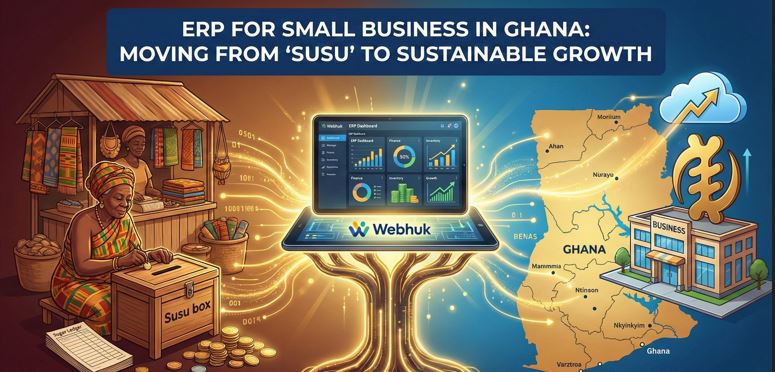
For generations, the "Susu" system has been the financial heartbeat of Ghana’s informal sector.
It is a brilliant system built on trust. A collector comes to your market stall in Makola or Kejetia, takes your daily contribution, and returns it at the end of the month to help you restock. It works perfectly for survival.
But what happens when you want to move beyond survival?
What happens when you need a GH₵ 500,000 loan from a commercial bank to expand to a new location? The bank manager won't look at your Susu card. They won't look at the handwritten notebook where you track your sales. They want audited financial statements. They want to see your inventory turnover ratio. They want proof of "Sustainable Growth."
This is the ceiling that hits thousands of successful Ghanaian businesses. They have the sales, but they lack the system.
The bridge between being a "shop" and being a "company" is ERP for small business in Ghana.
In this guide, we will explore how moving from informal notebooks to formal digital systems is the only way to unlock capital, manage multiple branches, and survive the new GRA tax landscape.
The Limitation of the "Notebook" Manager
Many Ghanaian entrepreneurs run their businesses entirely from memory. You know exactly how many bags of rice are in the warehouse and how much the supplier is owed—but only you know.
This creates three dangerous traps:
- You Cannot Leave: If you travel to China for imports or attend a funeral in the village, your business pauses because no one else has the data.
- Theft is Easy: "Leakage" is common in Ghanaian retail. Without a digital stock system, employees can easily under-report sales or take items home, and you will only realize it during the end-of-year stock take.
- You Look Risky to Banks: To a loan officer, a business without digital records is high-risk. They cannot verify your cash flow, so they either deny the loan or charge you punishingly high interest rates.
What is ERP in the Ghanaian Context?
Forget the technical jargon. An ERP (Enterprise Resource Planning) system is simply a "Digital Truth."
Instead of having a notebook for sales, a WhatsApp chat for orders, and a spreadsheet for expenses, an ERP puts everything in one app.
- When you sell an item in your Accra store, your inventory count drops instantly.
- The system automatically records the revenue for your accountant.
- If stock is low, it alerts you to reorder before you run out.
It turns your business into a machine that runs smoothly, even when you aren't there.
3 Reasons Why Ghanaian SMEs Are Switching to ERP
1. Securing "Formal" Capital
The Susu collector can give you small capital, but for serious growth, you need the banks. An ERP system generates professional Profit & Loss (P&L) statements and Balance Sheets with one click. When you walk into a bank with these generated reports, you aren't just a trader asking for money; you are a Director presenting a business case. It creates the "financial credibility" required to access lower-interest loans.
2. Managing the "Spintex vs. Makola" Problem
As you grow, you might open a second branch. Maybe one in the busy Central Business District and another in a residential area like Spintex or East Legon. How do you manage both? You can't be in two places at once. A cloud-based ERP allows you to see the dashboard of both shops from your phone. You can see live sales data: "Branch A sold GH₵ 5,000 today, but Branch B only sold GH₵ 1,000." You can transfer stock between branches digitally without losing track of a single item.
3. Surviving the GRA E-VAT Mandate
The Ghana Revenue Authority (GRA) is getting strict. The new GST/VAT invoicing software Ghana regulations mean that manual VAT invoices are being phased out. If your business is VAT-registered, you need software that connects to the GRA’s API to issue certified invoices. Using an ERP ensures you are compliant by default. Every sale you record is tax-ready, saving you from the dreaded "padlock" on your shop door during enforcement exercises.
But Isn't ERP Expensive?
Ten years ago, only big companies like Unilever or Tullow Oil could afford ERPs. They cost thousands of dollars to install.
Today, cloud ERP for SMEs has changed the game.
- Pay in Cedis/Affordable Rates: You pay a monthly subscription, often less than the cost of one employee's salary.
- No Servers Required: You don't need to buy a big computer or hire an IT guy. The software lives on the internet (Cloud), accessible via MTN/Vodafone 4G.
- Modular Growth: Start with just the "Inventory" and "Sales" modules. As you grow, add "HR" or "Manufacturing."
Conclusion: Professionalize or Perish
The Ghanaian market is becoming more competitive. International brands are entering, and local competitors are upgrading their tech. The "Susu" mindset of informal management is no longer enough to win.
Implementing ERP for small business in Ghana isn't about abandoning your roots; it's about watering them so they can grow into a mighty tree. It gives you the freedom to step back from daily operations and focus on the strategic deals that will double your revenue.
Ready to graduate from the notebook? Webhuk offers tailored business software that understands the Ghanaian market—from multi-currency imports to GRA compliance.
Frequently Asked Questions (FAQs)
1. Will an ERP work if my internet connection is bad?
Yes. Modern ERPs designed for Africa often have "offline modes." You can continue to make sales and print invoices even if the network is down. The system saves the data and automatically uploads it to the cloud the moment the internet comes back.
2. Can I use an ERP to track mobile money payments?
Absolutely. In Ghana, MoMo is king. A good ERP allows you to record payments from MTN Mobile Money, Vodafone Cash, or AT Money distinct from cash or bank transfers. This makes balancing your books at the end of the day much faster.
3. Is my data safe from competitors?
Far safer than a notebook lying on a counter. Cloud ERPs utilize bank-grade encryption. You can also set "User Permissions"—for example, your sales girl can see the price of an item to sell it, but she cannot see your total profit margins or your supplier list.
4. How does ERP help with imports?
If you import goods, you know the pain of exchange rates. An ERP handles multi-currency accounting. You can enter the purchase in Dollars or Yuan, and the system calculates the "Landed Cost" in Cedis, ensuring you set a selling price that actually makes a profit.
5. Do I need to fire my accountant if I get an ERP?
No. An ERP makes your accountant better. Instead of paying them to do data entry, you give them a login to the system. They can then log in remotely to audit your accounts and give you tax advice, which is a much better use of their fees.