Introduction
As African businesses move away from spreadsheets and manual systems, one major ERP decision stands in the way of success:
Should we choose Cloud ERP or On-Premise ERP?
Both deployment models have advantages and risks. However, the African business environment introduces unique factors such as internet reliability, data security concerns, operational scale, and cost sensitivity.
This guide provides a practical, ground-level comparison of Cloud ERP vs On-Premise ERP, helping businesses across Ghana, Nigeria, Kenya, South Africa, and other African markets make the right ERP decision in 2026.
What Is Cloud ERP?
Cloud ERP is hosted on remote servers and accessed via the internet. Businesses typically pay a subscription fee and access the system through a web browser.
Key Characteristics of Cloud ERP
- Hosted on third-party servers
- Accessible from anywhere
- Faster deployment
- Lower upfront infrastructure cost
- Automatic updates
Cloud ERP has gained popularity among SMEs due to its flexibility and lower entry barrier.
What Is On-Premise ERP?
On-Premise ERP is installed on servers located within the company’s own premises or private data center.
Key Characteristics of On-Premise ERP
- Hosted internally
- Full control over data and infrastructure
- Higher upfront cost
- Longer deployment timeline
- Internal IT dependency
On-premise ERP is traditionally preferred by organizations with strict data control requirements.
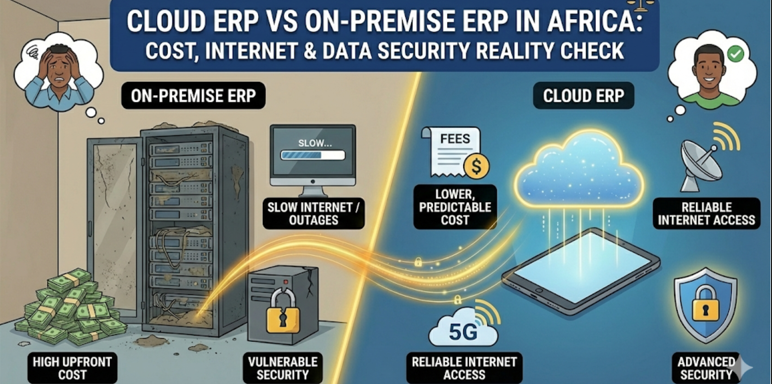
Cost Comparison: Cloud ERP vs On-Premise ERP in Africa
Cloud ERP Cost Reality
- Subscription-based (monthly or annual)
- Lower initial investment
- Ongoing recurring cost
- Reduced IT infrastructure expenses
On-Premise ERP Cost Reality
- High upfront license and server cost
- Hardware and maintenance expenses
- Internal IT staffing cost
- Lower recurring software fees over time
Key Insight:
For most African SMEs, Cloud ERP is easier to start, while On-Premise ERP becomes economical only at scale.
Internet Dependency: The African Reality
Cloud ERP and Internet Reliability
Cloud ERP depends heavily on stable internet connectivity. In regions with inconsistent connectivity, this can affect daily operations.
However, modern Cloud ERP solutions mitigate this through:
- Optimized performance
- Lightweight interfaces
- Process-based workflows
On-Premise ERP and Offline Control
On-Premise ERP allows internal network access even during internet outages, making it suitable for locations with unreliable connectivity.
Decision Tip:
Businesses must assess their operational dependency on real-time internet access before choosing Cloud ERP.
Data Security & Compliance Concerns
Cloud ERP Security
Cloud ERP providers typically offer:
- Encrypted data storage
- Regular security updates
- Professional server management
However, businesses often worry about:
- Data location
- Third-party access
- Regulatory compliance
On-Premise ERP Security
On-premise systems provide:
- Full data ownership
- Internal access control
- Custom security policies
But security depends entirely on internal IT discipline and maintenance.
Reality Check:
Security failures occur more often due to poor processes—not deployment model.
Scalability & Growth Considerations
Cloud ERP Scalability
- Easy to add users
- Supports multi-branch operations
- Ideal for fast-growing businesses
On-Premise ERP Scalability
- Requires hardware upgrades
- Longer expansion timelines
- Higher technical planning
For African businesses planning regional expansion, Cloud ERP offers faster scalability.
Which ERP Model Fits African Businesses Better?
Cloud ERP Is Better If You:
- Are an SME or mid-sized busines
- Operate across multiple locations
- Want faster deployment
- Prefer predictable costs
On-Premise ERP Is Better If You:
- Have strict data control requirements
- Operate in low-connectivity areas
- Maintain a strong internal IT team
- Prefer long-term ownership
Hybrid ERP: A Practical Middle Path
Many African businesses adopt a hybrid ERP approach, combining:
- Centralized cloud access
- Controlled on-premise data handling
This balances flexibility with control and is gaining popularity across industries.
Final Thoughts
Choosing between Cloud ERP and On-Premise ERP is not about trends—it’s about business reality.
African businesses must evaluate:
- Cost structure
- Internet reliability
- Data sensitivity
- Growth plans
The right choice is the one that supports operations today while remaining flexible for tomorrow.
Call to Action
Still unsure whether Cloud ERP or On-Premise ERP is right for your business?
Choosing the wrong ERP deployment model can lead to unnecessary costs, performance issues, and long-term operational challenges. Every business operates differently, and the right ERP decision depends on your internet reliability, data sensitivity, growth plans, and internal IT readiness.
Get a free ERP deployment assessment to understand:
- Which ERP model fits your current operations
- Future scalability considerations
- Cost implications over time
- Deployment risks to avoid
Make an informed ERP decision today—before implementation mistakes become expensive.
FAQs
1. Is Cloud ERP safe for African businesses?
Yes. Cloud ERP can be highly secure when implemented with proper access control, data policies, and vendor accountability.
2. Does Cloud ERP work with poor internet connectivity?
Cloud ERP requires internet access, but performance depends on system design and operational planning.
3. Is On-Premise ERP outdated?
No. On-Premise ERP remains relevant for businesses needing full control over data and infrastructure.
4. Which ERP model is cheaper in the long run?
Cloud ERP is cheaper initially, while On-Premise ERP can become cost-effective at larger scales.
5. Can businesses switch from Cloud ERP to On-Premise later?
Yes. With proper planning and modular architecture, businesses can migrate or adopt hybrid models.